Business Risk Icons for Streamlined Workflow and Visual Clarity
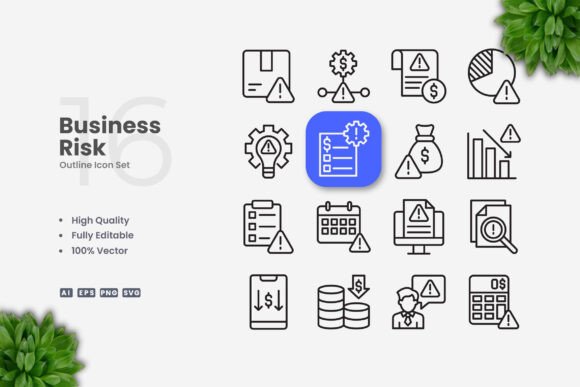
Business risk icons are essential visual tools that help convey complex ideas in a simple, recognizable format. These icons serve as a universal language, making it easier to communicate potential challenges, threats, or uncertainties within a project, decision-making process, or business strategy. Whether you're designing a presentation, developing a mobile app, or creating marketing materials, business risk icons can enhance clarity and improve user understanding.
Designed with simplicity and professionalism in mind, these icons are ideal for a wide range of applications. From websites and social media posts to infographics, flyers, and banners, they offer a consistent visual style that aligns with modern design trends. Their clean aesthetic ensures they blend seamlessly into any layout without overwhelming the viewer.
How Business Risk Icons Fit Into Broader Processes
Business risk icons play a crucial role in various stages of planning, execution, and evaluation. Before starting a project, they can help identify potential pitfalls and guide risk assessment. During implementation, they can signal areas requiring attention or additional resources. After a task is completed, they can be used to document lessons learned and inform future decisions.
In creative workflows, these icons can be integrated into mood boards, wireframes, or storyboards to highlight areas of concern. For educators and trainers, they can be used to illustrate case studies or real-world scenarios. In personal goal-setting, they can serve as visual reminders of possible obstacles and encourage proactive problem-solving.
Integration With Other Tools and Resources
Business risk icons work well alongside other design elements, such as charts, graphs, and diagrams. They can be combined with color coding, labels, or annotations to create more informative visuals. When used in conjunction with project management software, they can help teams track risks and monitor progress effectively.
These icons also complement other assets like infographics, presentations, and digital content. Their vector format allows for easy scaling and customization, ensuring they maintain quality at any size. This flexibility makes them a valuable addition to any designer’s toolkit, especially when working across multiple platforms and formats.
Practical Implementation Tips
To get the most out of business risk icons, consider the following tips:
- Choose the Right Icon for the Context: Select icons that accurately represent the type of risk being communicated. For example, use a warning sign for potential hazards, a lock for security concerns, or a chart for financial risks.
- Use Consistent Styles: Maintain a uniform look and feel across all icons to ensure visual harmony. This includes matching stroke weights, colors, and spacing.
- Test for Readability: Ensure that icons are clear and easily distinguishable, even at smaller sizes. Avoid overly complex designs that may confuse the audience.
- Combine with Text: Pair icons with brief explanations or labels to reinforce their meaning, especially when targeting diverse audiences.
Workflow Examples and Use Cases
Here are a few examples of how business risk icons can be applied in different scenarios:
- Project Planning: Use risk icons to mark areas of uncertainty in a project timeline. This helps stakeholders quickly identify high-risk tasks and allocate resources accordingly.
- Marketing Campaigns: Incorporate icons into social media posts or email newsletters to highlight potential challenges, such as budget constraints or market volatility.
- Training Materials: Add risk icons to e-learning modules or handbooks to emphasize important considerations during training sessions.
- Financial Reports: Include icons in dashboards or reports to visually represent financial risks, such as market fluctuations or credit defaults.
Factors to Consider for Long-Term Use
When integrating business risk icons into your workflow, consider factors such as preparation, compatibility, and usability. Ensure that the icons are compatible with your design software and that they can be easily edited or resized as needed. This is especially important if you plan to use them across multiple platforms or in different formats.
Consistency is key when using icons over time. Establish a set of guidelines for their use to maintain a cohesive visual identity. Regularly review and update your icon library to reflect new risks or changes in your workflow.
Quality control is also essential. Verify that all icons meet the required standards for resolution, color accuracy, and file format. This ensures that they perform well in both digital and print environments.
Conclusion: Enhancing Communication Through Visual Clarity
Business risk icons are powerful tools that enhance communication, streamline workflows, and improve decision-making. By incorporating them into your projects, you can convey complex information more effectively and support better outcomes. Whether you're a professional, creator, or entrepreneur, these icons offer a practical solution for visualizing risks and opportunities in a clear and consistent manner.